

Outsourcing in Europe 2015

Outsourcing in Europe 2015

Outsourcing hits record levels in Europe – Summer 2015

Outsourcing activity in Europe recovers after the lull in the lead up to the UK general election, with more contracts negotiated than ever before

The value of outsourcing contracts in the UK increased by 150% in the three-month period to the end of June 2015, as Europe saw a record number of contracts awarded.

In its latest index of IT and business process outsourcing contracts, Information Services Group (ISG) recorded 169 deals valued at €4m or more, with a total value of €2.2m.

This is welcome news for the outsourcing sector in Europe, which suffered a 25% fall in spending in the first three months of the year. ISG blamed this on caution in the run up to the UK general election.

In EMEA – the world’s largest outsourcing market – there were 128 contracts signed, valued at $2.4bn, according to the latest figures from ISG. Both these were 25% lower than the same period in 2014.

A drop in outsourcing in the UK – which dominates the area’s outsourcing market – had a big impact on the EMEA and global figures. “The drop was due mainly to a drop in sourcing business in the UK, due to the election,” said ISG.
Global outsourcing slowed as contract value reduced in a price war among suppliers, said ISG.

ISG’s Outsourcing Index – which measures commercial outsourcing contracts with annual contract value (ACV) of $5m or more – show first-quarter contract value fell 18%, to $5.1bn, well below the average for first quarters since 2006 of $6bn.

The number of contracts for the second quarter of 2015 was the highest ever, but the total value was 12% lower than the same period a year ago, with only two mega-deals worth €80m or more signed.

The financial services and energy sectors recorded a lot of activity in the period, while there was a decline in contract activity in the manufacturing, transportation and telecoms sectors.

ISG Europe partner and President John Keppel said the outsourcing industry is seeing an increase in smaller deals. “More deals than ever are being signed at much lower contract values, driven by increased use of multi-sourcing and the impact of digital strategies. The ever-increasing activity levels in Europe, the Middle East and Africa indicate that outsourcing is more popular than ever,” he said.

Keppel said of multi-sourcing, where buyers seek shorter and smaller contracts with niche providers, is driving this.

“Digital disruption is also having a significant impact, with buyers avoiding larger, longer-term contracts as they plan their digital strategies amid a wave of new technologies and operating model,” he said.

In the UK both the value and the number of contracts increased by 150%.

Keppel said ISG is bullish in the short-term and expects the next quarter to record growth compared with 2014. “Longer term, it will be interesting to see how the trend toward a higher number of lower value contracts plays out in the second half of 2015,” he said.

But what about the Financial Services sector?

Since the start of Q2 2015 there is expected to be an increase in the use of IT outsourcing in the global banking sector for the next 12 months, but the use of expensive consultants [The Big5] will drop, according to research by Finextra.

The CSC-sponsored research, which surveyed more than 50 global banks at the end of 2014, showed banks are cautious over what they spend on IT.

It also revealed that 49% of banks plan to increase the use of IT outsourcing over the next 12 months, while only 9% of the banks said they will reduce IT outsourcing.

Some 42% said they will reduce their use of consultants, while 22% are set to increase their use. Contractors will be increasingly used by 40% of banks, but 37% will reduce the number they use. The research also showed that internal IT headcounts will increase at 35% of banks, but reduce at 32%.

The numbers suggest banks are eager to develop IT but are conscious of the need to keep costs down, with Big5 consultants’ notoriously expensive resources.

“More often than not the Big5 – consultants are twice the daily rate compared to independent interim IT contractors, so moving to the smaller bespoke interim consulting market it’s a quick way to shed costs,” states Craig Ashmole, Founding Partner at London based IT Consulting CCServe. “The report indicates more judicious usage of consultants mainly for advisory and design activity, leaving the implementation to the organisation themselves. Interim consultants being a useful source of reliable skills.” he said.

Outsourced IT is the fastest growing resource. The flexibility and cost advantages of suppliers that can tap resources in low-cost regions are increasingly popular for banks. “A wide range of flexible models incorporating outsourcing, offshoring and even insource-offshoring deals are being pursued,” said the report.

Allied Irish Bank and ABM Amro are examples of banks that have recently increased IT outsourcing but banks may be taking risks by outsourcing and offshoring some of their legacy operations, as well as their security.

Having spent a majority of my career working with and supporting the Corporate CIO Function, I now seek to provide a forum whereby CIOs or IT Directors can learn from the experience of others to address burning Change or Transformation challenges.

Craig Ashmole

Founding Director CCServe

Cloud Affecting India Outsourcing

Cloud Affecting India Outsourcing

Cloud Computing Is Going To Rain on India’s Outsourcing Parade

There are dark clouds on the horizon of India’s information technology and outsourcing industry.

AstraZeneca PLC is sharply scaling back the business it gives to the Indian outsourcing companies that it has long relied on for tech help. David Smoley, AstraZeneca’s technology chief, said he expects to cut in half the $750 million the drug maker used to spend annually on outsourcing over the next two years. He said the number of people working on information technology also would drop by 50%.

The changes at AstraZeneca are part of a major shift toward cloud computing, which is starting to bite into the revenue and profits as well as hiring in India’s critical outsourcing industry and poses an existential threat to the players that fail to adapt.

Outsourcing executives are bracing for a big disruption. “It’s like what happened when Amazon arrived,” said C.P. Gurnani, chief executive of Tech Mahindra Ltd., a large Pune-based outsourcer that specializes in work for telecommunications companies. U.S. bookstore chain Borders closed and Barnes & Noble had to reinvent itself, Mr. Gurnani said.

Mritunjay Singh, operating chief of outsourcer Persistent Systems, predicts a “bloodbath” in which only nimbler companies will survive.

Outsourcing accounts for around 20% of all of India’s exports of goods and services. The industry employs millions of Indians and has become an important route into the middle class in the world’s second-most populous country.

The impact of the move to cloud computing — where servers and software are accessed via the Internet rather than on local networks or personal computers — is being amplified by other trends, from automated code-writing to increased competition and falling corporate information-technology budgets.

There are dark clouds on the horizon of India’s information technology and outsourcing industry. Profit growth at even India’s most successful and sophisticated software companies could be doused as companies, governments and consumers around the world do an increasing amount of their computing on the cloud, says outsourcing services advisory firm ISG Inc.

Companies that have traditionally used in-house servers running on custom-made applications are putting more of their business on external servers and using off-the-shelf software. Using the cloud often means using fewer people so Indian software companies—once dubbed “body shops” because they could supply as many computer engineers as a project needed—are going to suffer as they lose much of their competitive advantage.

“It is only going to get cheaper and easier for companies to switch to the cloud, outsource providers need to get ready for the storm and modify their business models and move with the digital times”, said Craig Ashmole, Founding Partner of London based IT Consulting CCServe Ltd.

This means, developing software that allows businesses to (interact) faster and more efficiently with their external stakeholders – customers and suppliers, rather than focus on changes to the internal workings of a client.

Around one in four of the deals ISG helped advise involved cloud computing last year. That’s more than three times more than the percentage of cloud deals it saw three years earlier.

India’s software and outsourcing companies are still too reliant on the business model that uses lots of relatively inexpensive Indian engineers and sends them to client sites to build software and fix problems, ISG and other analysts say.

Cloud providers use external servers, sophisticated technology and automation to manage clients’ data using fewer employees. Where a traditional service provider deploys one employee to monitor up to 200 servers, cloud players can use one employee to monitor up to 10,000 servers, ISG estimates.

The cloud infrastructure players are drastically cutting down prices and starting to create pricing pressure on service providers in India and elsewhere who continue to set contracts based on the number of engineers deployed in a project.

Cloud infrastructure providers such as Amazon Web Services, Red Hat, Rackspace Hosting and others are emerging as a formidable threat to Indian outsourcers and other traditional service providers and consultants including IBM and Accenture that earn revenues from managing the technology infrastructure of clients.

Traditional service providers now have to strive to get more cloud contracts–where they help clients shift data to cloud infrastructure providers–rather than focusing on creating their own clouds, ISG said.

Having spent a majority of my career working with and supporting the Corporate CIO Function, I now seek to provide a forum whereby CIOs or IT Directors can learn from the experience of others to address burning Change or Transformation challenges.

Craig Ashmole

Founding Director CCServe

Gartner findings on CIO role in 2015

Gartner findings on CIO role in 2015

Gartner findings on the CIO Role change in 2015

Takeaways from Gartner research on the ever evolving role of the CIO.

If you take a moment to scan the social media, technology is a constantly moving ball, but sadly the CIO role does not always move at the same pace and there’s a lot of discussion being written about CIOs where you’ll get a range of different perspectives — the job is fraught, constantly in flux, no one wants it, or the CIO has not moved into the digital arena fast enough.

“There is validity in all these views, some more so than others, and the fact that so many are discussing this on social media proves there’s a good reason to be addressing it,” says Craig Ashmole, Founding Partner at London based IT consulting CCServe. “What is clear to me however is the boardroom needs to take the ‘bull-by-the-horns’ now, by asking those difficult questions:- Do we have the right CIO for the job?

It would be naive to think that the CMO or even the evolving CDO (Chief Digital Officer) role can really just walk in and replace the CIO and the company will carry on from a technology perspective. If the CIO is addressing their technology department by moving to a world of innovative leadership and commoditising the utility elements of IT then the CIO is well on the road to getting things right.

So, how to get a grip on what’s going on in the world of the CIO? Reading a recent blog I notice that it is a serious C-Change environment, here’s a rundown of some of the most recent data from research firm Gartner about the role of the CIO, from the descriptive to the prescriptive over the first 8 months of 2015.

Perception is important

According to the Gartner report “CIOs Should Consider a New Approach to User Satisfaction,” perception of IT performance plays a significant role in how CIOs view the extent to which IT is delivering on executive expectations. The unfortunate thing here, the report says, is that what executives expect isn’t always matched up with what IT is actually able to deliver. The report details better methods of gauging satisfaction by asking the right kinds of questions to the right people in the company. It describes CIOs as bridge builders, in part by “[enabling] business leaders to better interpret the needs of their organisations.”

The percentage of female CIOs has plateaued

In Gartner’s CIO Agenda 2015: A Gender Perspective, 337 of the 2,473 respondents were women, which is about 13.6% of the sample. That percentage fits into the worldwide average of female CIOs, which is estimated from 10-14%. Gartner said the numbers have plateaued and actually are fairly similar to the plateaus found in the numbers of women in senior positions in non-technology leadership roles.

Women CIOs expect greater budget increases in 2015, more so than male CIOs

The breakdown is 2.4% vs. 0.8%. It’s unclear why exactly that is, but it’s happened two years in a row. Gartner did point out that other previous data showed that when it comes to risk management, women CIOs were more concerned about underinvestment in risk initiatives. Risk data plus budget numbers might hint toward women putting more attention toward resources.

Software-defined infrastructures, IT service continuity, and integrated systems are the top 3 emerging trends that will affect CIOs’ decision-making this year.

When looking at these trends, Gartner recommends a trio of being aware, engaged, and proactive. That means tracking trends, understanding how they’ll affect current, new, or future operations, placing them on the “shortlist” for things to evaluate or implement. The report describes a situation where people expect to have access to everything always, and as a CIO, merely delivering on that expectation is the “bare minimum.”

CIOs should take another look at their company’s chief strategy officer

Gartner put out an entire report focusing on this idea, saying that culturally, even though CSOs are c-suite, they’re often viewed as “externalities” and even treated with suspicion. In the digital business era, that should be the case, and the report talks about how CSOs increasingly affect the IT and digital business agenda.

Men and women CIOs are more similar than different

One of the report’s recommendations was to avoid gender bias as it found that there are actually more similarities than differences between men and women CIOs in their approaches to leadership, how they view technology, and how they handle digital leadership priorities. For example, the top two tech priorities for men and women CIOs in 2015 are BI/analytics and infrastructure and data centre. Women put cloud ahead of ERP in the third and fourth spots, and both put mobile as no. 5. Similarities went on from there.

Publicly announced initiatives are up

When looking at the world’s largest insurers (CIOs of World’s Largest Insurers Continue to Invest in Digital Transformation), Gartner found an increase of 10% in publically announced IT initiatives as compared to 2013. They interpreted this as a possible indicator of growth in IT spending.

A large chunk of those initiatives are mobile apps and digitisation

Gartner said about a third of publicly announced initiatives were digitisation (18%) and mobile applications (15%). They recommend looking at these trends as a point of comparison and seeing where one’s own company was in relation to market trends.

One thing not addressed by specifically by Gartner however is; how the boardroom gets their CIO to change if they have not already done so. The first and primary move should consider external support to bring creative recommendations to the table the secondary move should be the actual transition based on the revised TOM.

“There is the obvious Big-5 consultancy houses that can be approached and are so often used, but don’t neglect to consider the huge pool of innovative and agile interim consulting and transformation resources from the smaller boutique marketplace.” comments Craig Ashmole. “These interim independent resources are often well qualified for this change game, especially where it’s to support existing CIOs for short periods of skills Top-up”.

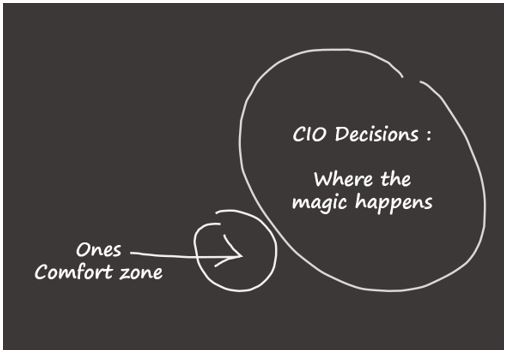
Boardrooms should do less finger pointing but enable the CIO function to transition as quickly as possible and don’t look at skills augmentation as a failure but as a means to take the CIO from their present comfort zones to where the “IT Magic” is.

Having spent a majority of my career working with and supporting the Corporate CIO Function, I now seek to provide a forum whereby CIOs or IT Directors can learn from the experience of others to address burning Change or Transformation challenges.

Craig Ashmole

Founding Director CCServe

IT Consulting Straight Talk

IT Consulting Straight Talk

Do Businesses need more “Straight Talking” IT Consulting?
There’s one thing that’s in short supply in almost every organisation, at every level, and that’s straight talking – business frankness.

It’s business’s biggest dirty little secret that in most companies, most people would hide or spin the truth rather than openly share it, making it harder for decision makers to bring the reality of the situation to the surface in order to fix it.

That’s human nature of course, and we all have an innate instinct that tells us from a young age to prevent awkwardness and avoid hurting people’s feelings. Or possibly we’re afraid of the very real organisational consequences of being candid in a company culture that doesn’t welcome openness.

But, assuming your organisation wants it, getting that frankness right – with your direct reports, your peers, or your management line – is a skill that could make or break a career or even a consulting engagement.

“Getting the overall approach ‘right’ as an interim transformation or change consultant is a key part of the no nonsense ‘straight Talking’ professional approach I do on a daily basis.” says Craig Ashmole, Founding Partner of London based CCServe. “Getting this wrong can however have profound ramifications, but experience learned over time, avoids these mistakes”.

The two biggest challenges I come across, especially in interim IT consulting assignments, is the management of political change – for example; a senior executive or head of department looking to make major change will touch many other areas or people within that organisation — this naturally becomes a political ‘hot potato’. Being sensitive to people and listening to feedback is a key element to managing this process.

The other challenge, is being able to professionally but candidly tell the very leaders of the company whom have brought you into their business that their people, structure or operational process are failing the business. Ensure that the message is sensitively, factually and accurately articulated and address the issues head on, which is easier said than done.

Non-IT roles now control many of the most interesting and innovative aspects of corporate IT, while the CIO is being saddled with a massive portfolio of “utility” technologies that only generate interest when they fail. In addition the “death” of the CIO role has long been discussed and predicted, often due to the role disappearing, rather than the decrease in the number of people interested in filling the role.

There’s now a legitimate need for operationally-focused IT leaders who can manage a squad of staff that “keep the lights on” while also formulating a strategic IT digital change and vision. Where the CIO role is inherently flawed however is that it often expects the same person to be equipped to handle both these diverse disciplines.

At the executive level, companies should consider separating the operational and strategic disciplines, depending on the needs of the company. As cloud services and the ability to outsource many operational or back office functions, there’s an opportunity to accelerate this shifting separation. Even without resorting to external parties, savvy companies can equip CIOs with the appropriate authority and discretion to build effective operational staff, and stop expecting that CIOs should be equal parts strategist and technician.

Essentially, the CIO role becomes an ‘executive level internal consultant’ who charts the future course for corporate IT, and leverages internal and external resources to execute that vision of IT Business make over, while addressing business issues, needs and social agendas with the ‘right’ use of technology either on-premise or in the cloud.

“Countless years exposure with the CIO layer has convinced me that many CIOs even now in the digital twenty twenties need broader business experience than has typically been required in the past – more commercial business acumen than the typical deep technical expertise of the past,” Craig Ashmole goes on to say. “The CIO needs to be a board level business led executive with the acumen to utilise technology to drive revenue growth”.

The no-nonsense “Straight Talking” approach is about quickly understanding the underlying issues the CIO is facing, while being agile and articulate but delivering quick short term change programmes that make immediate differences to the business.

Very often this is quite a different approach to that of the ‘Big 5’ consultancy houses. The Big-5 typically throw a large number of junior graduates at their business client, who typically provide hundreds of pages of ‘nice’ reports, only to predict there will be better operational improvement in future months to come – so long as the client signs up for months of committed engagement – well synically that’s what you would expect.

CCServe is a London based IT & Business Transformation Consultancy helping CIOs and Executive business leaders globally to move their IT into the 2020’s and beyond, quickly and cost effectively. We bring the ‘right’ resource to the table.

Having spent a majority of my career working with and supporting the Corporate CIO Function, I now seek to provide a forum whereby CIOs or IT Directors can learn from the experience of others to address burning Change or Transformation challenges.
Craig Ashmole

Founding Director CCServe

The CIO becomes the Chameleon In Chief

The CIO becomes the Chameleon In Chief

We are seeing a high volume of discussion on the expectations of the CIO and the need to change tactics

The two-speed CIO just isn’t going to cut it – tech chiefs need to be able to respond to changing environments and requirements more quickly than ever.

he modern CIO must act like a professional chameleon, changing their form and their IT function to suit the fast-changing business environment.

Analyst Garter suggests CIOs are fully aware that they will need to change in order to succeed in digital business, with 75 per cent of IT leaders saying they will need to adapt their style and skills during the next three years. The analyst talks of the need for executives to adopt a bi-modal stance to IT.

Modern CIOs, suggests Gartner, need a rock solid and efficient IT operation that, frees up time and resources for innovation. So, does the idea of a bi-modal CIO resonate with IT leaders and how can technology chiefs change their style to suit business need?

Does bi-modal IT resonate with CIOs?

Former CIO and digital advisor Ian Cohen says the keys to success in the digital age, such as understanding product management, behaviour, and sentiment, often have very little to do with the traditional view of enterprise IT. In fact, Cohen says the often used description of a bi-modal IT is nonsense.

“I still hear people talking about the need to manage both the back and the front office as if they are two separate things and are all you need to consider,” he says. “If you understand the power of technology, you’ll know that IT has always been multi-modal. The best CIOs already have responsibility for a broad range of digital transformation projects as part of their portfolio of management skills.”

Gartner says as many as 89 per cent of CIOs believe that the digital world is creating new types and levels of risk for their business. What is, perhaps, more surprising is that 11 per cent of CIOs do not recognise the change. For such IT leaders, a wakeup call is surely required. And as Cohen suggests, that moment could be fast approaching.

“If you don’t have that focus, there’s a big risk that you won’t be a CIO for much longer,” he says. “Ultimately, digital needs to be everyone’s responsibility – no single executive can own the digital agenda. But someone has to be the catalyst for transformation and the best CIOs are agents of change. It’s not about being bi-modal, it about your organisation – and the technology that enables and supports business – being multi-modal.”

Research suggests technology chiefs do understand the importance of responsiveness. Consultant Deloitte reports that more than two fifths (41 per cent) of executives recognise the importance of an agile delivery model to mature IT organisations. There is, however, confusion about how this state might be reached — and Tullow Oil CIO Andrew Marks is another executive who believes the phrase bi-modal IT is nonsense.

“There’s a lot of talk about the evolution of the CIO role, but technology management is, and always has been, multi-speed,” he says. “While IT leadership does change over time, it’s impossible to say how the position will change in the future or how many years it might take to reach the next stage of leadership.”

Marks’ suggestion is that the act of being a CIO is directly related to the context of the business within which an individual operates. And there isn’t a “CIO to order”; your career could go in any direction, such as working in operations, working for a start-up, and then returning back to work in IT.

“I don’t think you need the badge of successfully transforming a business through IT to be considered for your next role,” he says. “If you’re not into running continuous change initiatives, you will still be involved in milestone events, yet these tend to be subtle changes, rather than complete organisational transformations.”

How can CIOs change their style and meet business need?

The modern CIO, therefore, needs to be a multi-modal chameleon. There is an almost limitless amount of variations in form and function of the role due to the different demands in host organisations. What is more, some CIOs will not necessarily find it easy to adopt the right stance.

Stephen Hand, former CIO and principal consultant at Consult 360, says a willingness to think differently – particularly in regards to innovation – can be a big ask for IT leaders. Unlike other c-suite peers, technology professionals are not necessarily used to thinking in new and radical ways.

“The IT professional’s longstanding focus on governance, strategy, and information means many technology executives have more in common with the finance chief than some of their more entrepreneurial executive peers, especially those in the marketing and sales departments,” says Hand.

But an insular style of leadership is simply not an option. As businesses look to gain a competitive advantage from digital transformation, engagement seems to be the watchword for IT leaders, who must continue to spend less time in the data centre and more time facing internal and external customers.

David Reed, head of information services and infrastructure at the Press Association, picks up on this point, suggesting that successful CIOs spend as much time as possible trying to understand how technology can make a positive impact to the overall business.

“IT must align with both internal and external business objectives,” he says, stating that stakeholder management is an absolutely critical success factor for modern CIOs. “If the technology you implement doesn’t do anything for the bottom line, it’s a waste of time, and will lead you down the path to failure.”

Engagement requires commitment on both sides. Such close working is engrained into the working culture at Top Right Group. The media firm’s IT director Sean Harley says the technology team supports the firm’s product managers that are delivering new services for customers. Many of the projects being delivered have a strong digital element.

“Customers today want social interaction and personalisation,” he says. “Does a dedicated CDO give you an advantage in those areas? It’s debatable, but what I do know is that a decent product manager who knows their sector – and who works hand in hand with the technology team – can deliver those benefits. And that’s what we see in our organisation.”

Having spent a majority of my career working with and supporting the Corporate CIO Function, I now seek to provide a forum whereby CIOs or IT Directors can learn from the experience of others to address burning Change or Transformation challenges.

Craig Ashmole

Founding Director CCServe